
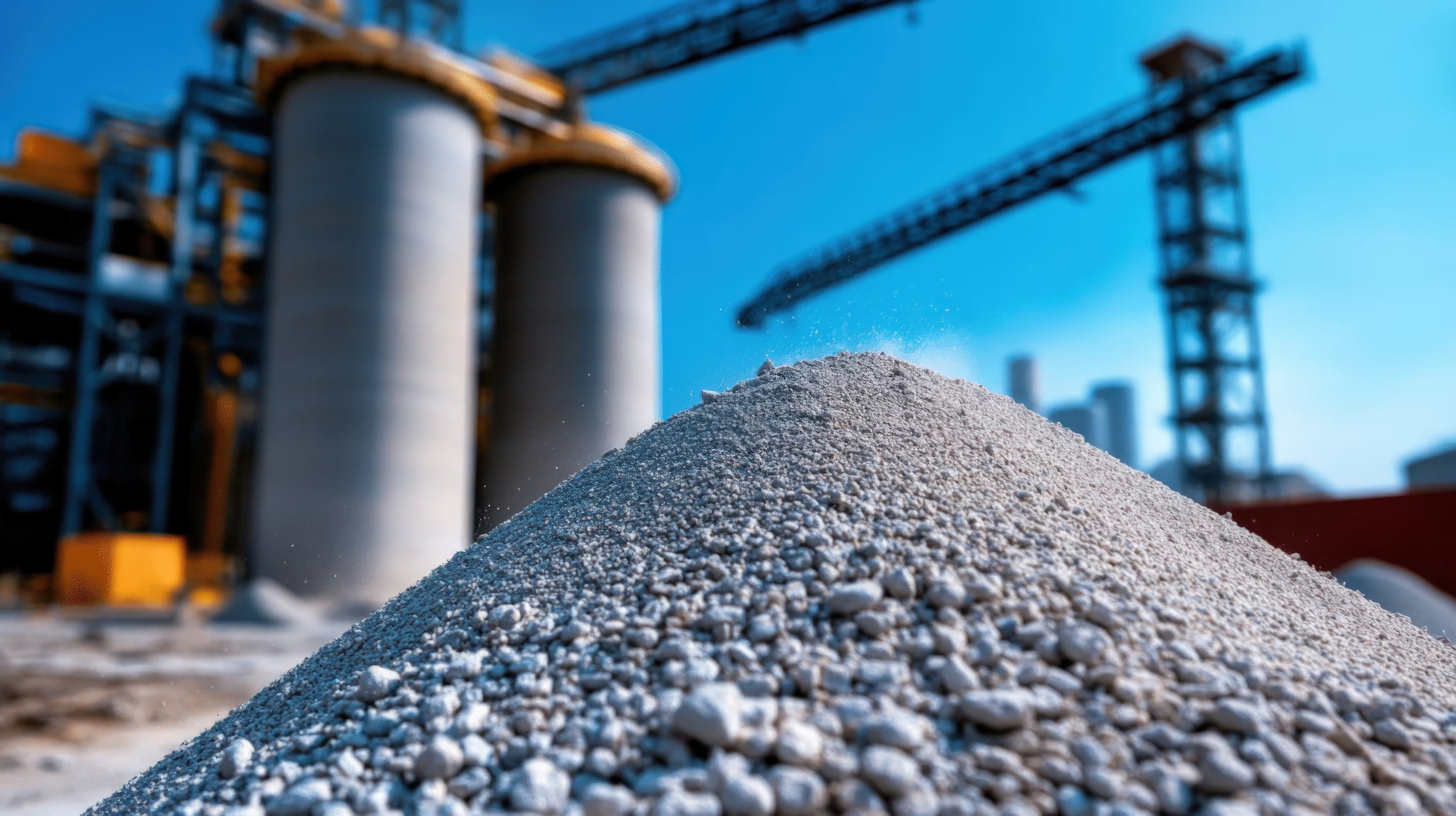
Cement carries roughly 8% of global CO₂ emissions, about 2.9 billion tonnes a year. South Asian manufacturing carries a disproportionate share. India alone produces ~440 million tonnes annually, second only to China; Pakistan, Bangladesh and Sri Lanka add another ~120 million between them. As CBAM enters its definitive phase in 2026 and India's Carbon Credit Trading Scheme (CCTS) begins pricing emissions from 186 named cement facilities, the question is no longer whether the sector decarbonises. It is how, in what order, and at what cost.
Definition What is CBAM? +
The Carbon Border Adjustment Mechanism (CBAM) is a European Union trade policy tool that prices the carbon embedded in imports of certain goods, including cement, steel, aluminium, fertilisers, and electricity. Importers must purchase CBAM certificates equal to the difference between the carbon price paid in the country of production and the EU ETS carbon price. In its definitive phase from 2026, CBAM directly exposes South Asian cement and steel exporters to European carbon pricing, making their emission intensity a commercial risk.
The structural fact that shapes everything: roughly 60% of cement's emissions don't come from burning fuel. They come from chemistry. When limestone is heated to make clinker, cement's active binding agent, CaCO₃ decomposes into CaO + CO₂. That release is intrinsic to the reaction. Use zero-carbon electricity, biomass, hydrogen, and you still emit ~520 kg of CO₂ per tonne of clinker. This is why cement is the textbook hard-to-abate sector, and why its decarbonisation path is unlike anything in textiles, automotive, or food processing.
Definition What is clinker? +
Clinker is the intermediate product of cement manufacturing, nodules of calcium silicates and aluminates produced by heating limestone (calcium carbonate) and clay in a rotary kiln at ~1,450°C. The calcination reaction releases CO₂ as a process emission, independent of the fuel used. Clinker is then ground with gypsum to produce ordinary Portland cement (OPC). Because process emissions are locked into the chemistry, reducing the clinker factor (the ratio of clinker to total cement) is the single largest structural lever for cement decarbonisation.
Here is the lever stack as it actually sequences in 2026.
Lever one, Thermal and electrical efficiency
The cheapest lever, and the one Indian industry has worked hardest. Best-in-class Indian plants now operate at ~675 kcal/kg clinker thermal energy and ~56 kWh/tonne electrical, close to global benchmark. Waste heat recovery (WHR) systems harvest kiln flue gases for power generation; UltraTech and Dalmia have deployed WHR across most large units. The remaining gap is the long tail of mid-sized plants and Pakistani / Bangladeshi units still running 750+ kcal/kg. Modest capex, fast payback, ~5–10% emissions reduction.
Lever two, Alternative fuels and raw materials (AFR)
The largest near-term opportunity. Thermal Substitution Rate (TSR), the share of fossil fuel replaced with waste-derived fuels (municipal solid waste, industrial waste, biomass, refuse-derived fuel), averages just 5–7% across Indian cement, against European best-in-class above 50%. The GCCA Concrete Future roadmap, signed by UltraTech, targets ~40% global TSR by 2030. AFR requires kiln retrofits, pre-processing infrastructure, and a stable waste supply chain, but capex is moderate and the operational economics work even before carbon pricing. For greenfield capacity, designing for high TSR from day one is the obvious move.
Definition What is TSR (Thermal Substitution Rate)? +
Thermal Substitution Rate (TSR) measures the share of a cement kiln's thermal energy demand supplied by alternative fuels, waste-derived fuels (municipal solid waste, biomass, refuse-derived fuel, hazardous industrial waste) rather than fossil coal or petroleum coke. A TSR of 10% means 10% of heat comes from alternative sources. European cement plants routinely run TSRs above 50%; India's average is 5–7%. Increasing TSR cuts both fuel costs and Scope 1 emissions without requiring changes to the clinker chemistry.
Lever three, The clinker problem (SCMs and LC3)
Reducing the clinker factor, the share of clinker in finished cement, is the single largest emissions lever. India's clinker factor was ~0.75 in 2020 against a global average of 0.63. The traditional supplementary cementitious materials (SCMs) are fly ash from coal plants and ground granulated blast-furnace slag (GGBS) from steel; Indian Portland Pozzolana Cement (PPC) blends already use ~30% fly ash and dominate the domestic market.
The structural problem: fly ash availability is declining as India phases down coal power and as dry ash quality becomes inconsistent. The next-generation lever is calcined clay. Limestone Calcined Clay Cement (LC3), typically 50% clinker, 30% calcined clay, 15% limestone, 5% gypsum, replaces up to 50% of clinker and delivers a 30–40% emissions reduction. India has abundant kaolinitic clay reserves, including medium-to-low grades suitable for LC3. Lodha is piloting India's first commercial LC3 application in Mumbai under the Net Zero Urban Accelerator (RMI India Foundation). Industry conservatism, ready-mix concrete supplier resistance, and IS standards updates are the current bottlenecks, not the chemistry.
Definition What is LC3 (Limestone Calcined Clay Cement)? +
LC3 (Limestone Calcined Clay Cement) is a blended cement technology developed at EPFL and IIT Madras that substitutes up to 50% of clinker with a combination of calcined clay and limestone. The typical mix is: 50% clinker, 30% calcined clay, 15% limestone, 5% gypsum. LC3 reduces CO₂ emissions per tonne of cement by 30–40% compared to ordinary Portland cement, works with medium- to low-grade kaolinitic clays (which are abundant in India, Africa and Latin America), and performs comparably to standard cement for most structural applications. It is widely seen as the most deployable near-term decarbonisation solution for South Asian cement markets.
Lever four, Carbon capture (CCUS)
Even with maximum efficiency, full AFR, and aggressive clinker substitution, roughly half the emissions remain, locked into calcination chemistry. CCUS is the only path to net zero from there, and the most expensive lever in the stack. Pilot-scale projects in India (Dalmia, JSW Cement) are exploring oxy-fuel combustion and post-combustion amine capture at $60–120/tCO₂. CCUS only becomes economic when carbon pricing, domestic via CCTS, external via CBAM, supplemented by Article 6 ITMOs or CCP-labelled removals revenue, closes the gap. Expect first commercial-scale Indian cement CCUS units late this decade.
Definition What is CCTS (India's Carbon Credit Trading Scheme)? +
India's Carbon Credit Trading Scheme (CCTS), notified under the Energy Conservation Act (amended 2022), is a domestic compliance carbon market that sets legally binding greenhouse gas emission intensity targets for designated energy-intensive industries. In H2 2026, it goes live for ~740 entities across nine sectors including cement, steel, aluminium, chlor-alkali, and paper. Facilities that beat their targets earn Indian Carbon Credits (ICCs); those that miss must purchase credits on the Indian Carbon Market (ICM), trading on power exchanges. The scheme creates a domestic carbon price relevant for both compliance planning and CBAM exposure calculations.
The policy and market gravity
Three forces are now pricing this lever stack.
CCTS in India: from H2 2026, 186 cement facilities have legally binding GHG emission intensity targets for FY26 and FY27, with credit trading on power exchanges. CBAM in Europe: cement importers pay the gap between embodied carbon and the EU ETS price, directly relevant for Indian, Bangladeshi and Pakistani cement exports. Demand-side procurement: Lodha, Mahindra Lifespaces and Indian government infrastructure (PMAY, NIP) are moving toward low-carbon specifications. The result: a low-clinker, high-AFR, WHR-enabled tonne of cement is now worth meaningfully more than a conventional one, and a high-clinker conventional tonne is now worth meaningfully less.
For South Asian cement manufacturers, the strategic logic is simple even if operationally hard. Sequence the levers correctly (efficiency → AFR → clinker substitution → CCUS), build for LC3 readiness now (clay reserves, calcination capacity, IS standards engagement), and monetise the carbon revenue stack (CCTS credits, CBAM premium, voluntary CCP-labelled removals from CCUS). The companies that get this sequencing right in the next 24 months will define the cost curve for the next decade.
Ennacle advises cement and heavy-industry manufacturers across South Asia on emissions baseline development, CCTS compliance strategy, AFR and SCM transition planning, and CBAM exposure modelling.